
Operations diagnostics and automation builds for founder-led businesses
Your business makes money. Behind the scenes, it is duct tape and spreadsheets.
That is fixable, and not with another hire or another tool. I find where the work actually breaks, then build the systems that hold without you.
No retainers. No proposals that take three weeks. Tell me what is broken.
Sound familiar?
-
OPS-101 Open
One status update means checking three systems, a spreadsheet, and Slack.
-
OPS-102 Open
Your AI "solution" still needs a human babysitter.
-
OPS-103 Critical
Your tools do not talk to each other.
-
OPS-104 Critical
Your customers find problems before your team does.
-
OPS-105 Open
Your processes live in someone's head, not in a documented system.
-
OPS-106 Open
You tried automation before. It did not stick.
-
OPS-107 Blocked
You are the escalation path. Every stuck order ends up on the founder's desk.
What I actually do.
What working with me looks like.
The broken workflow, the diagnosis, the build, and the numbers. Not summaries: the full documents.

Engagement case study
$40,000 found in 60 days
An $8M wholesale distributor paying invoices twice. A capture service, an AI extraction agent behind human approval, and one tracker of record.
Read the case study →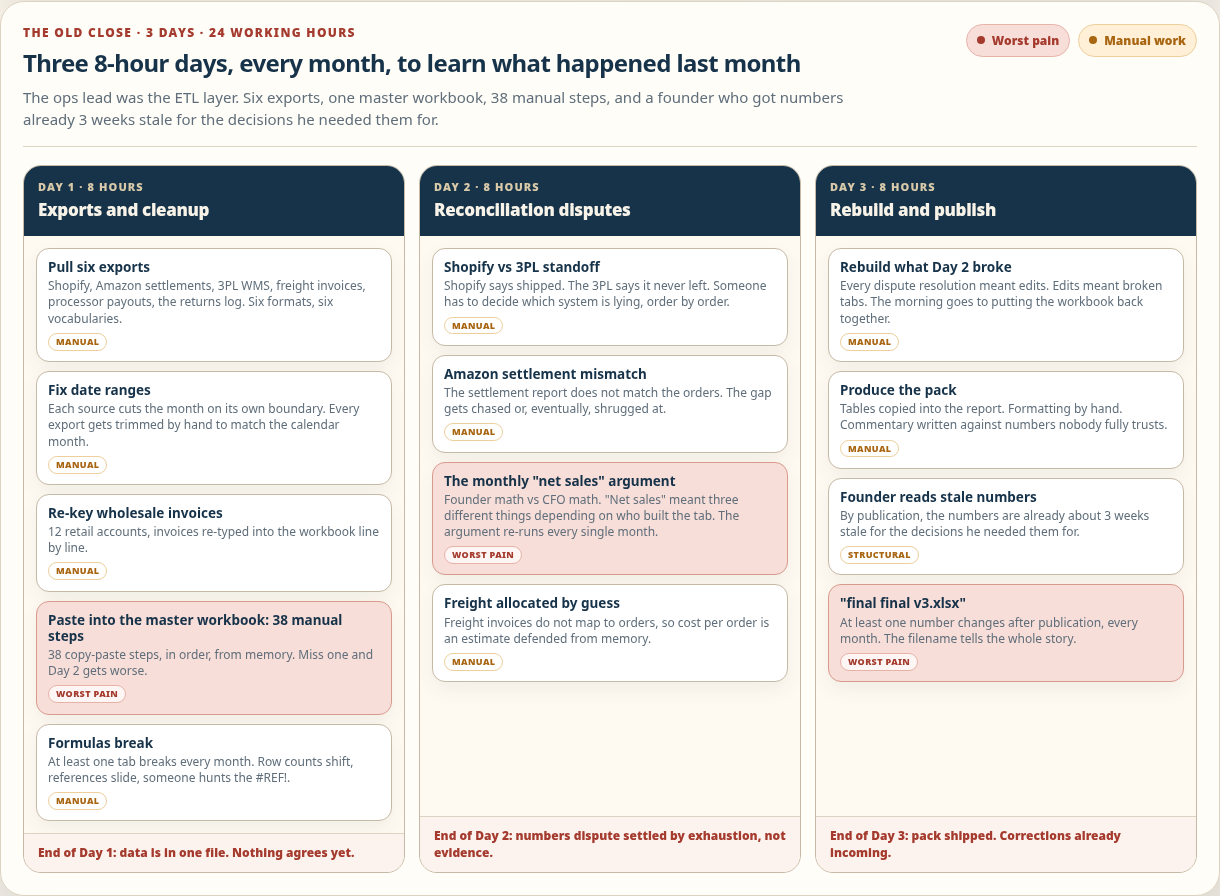
Engagement case study
Month-end close: 3 days to 4 hours
Six data sources that never agreed. Fourteen signed metric definitions, a nightly pipeline, and a reconciliation agent behind human review.
Read the case study →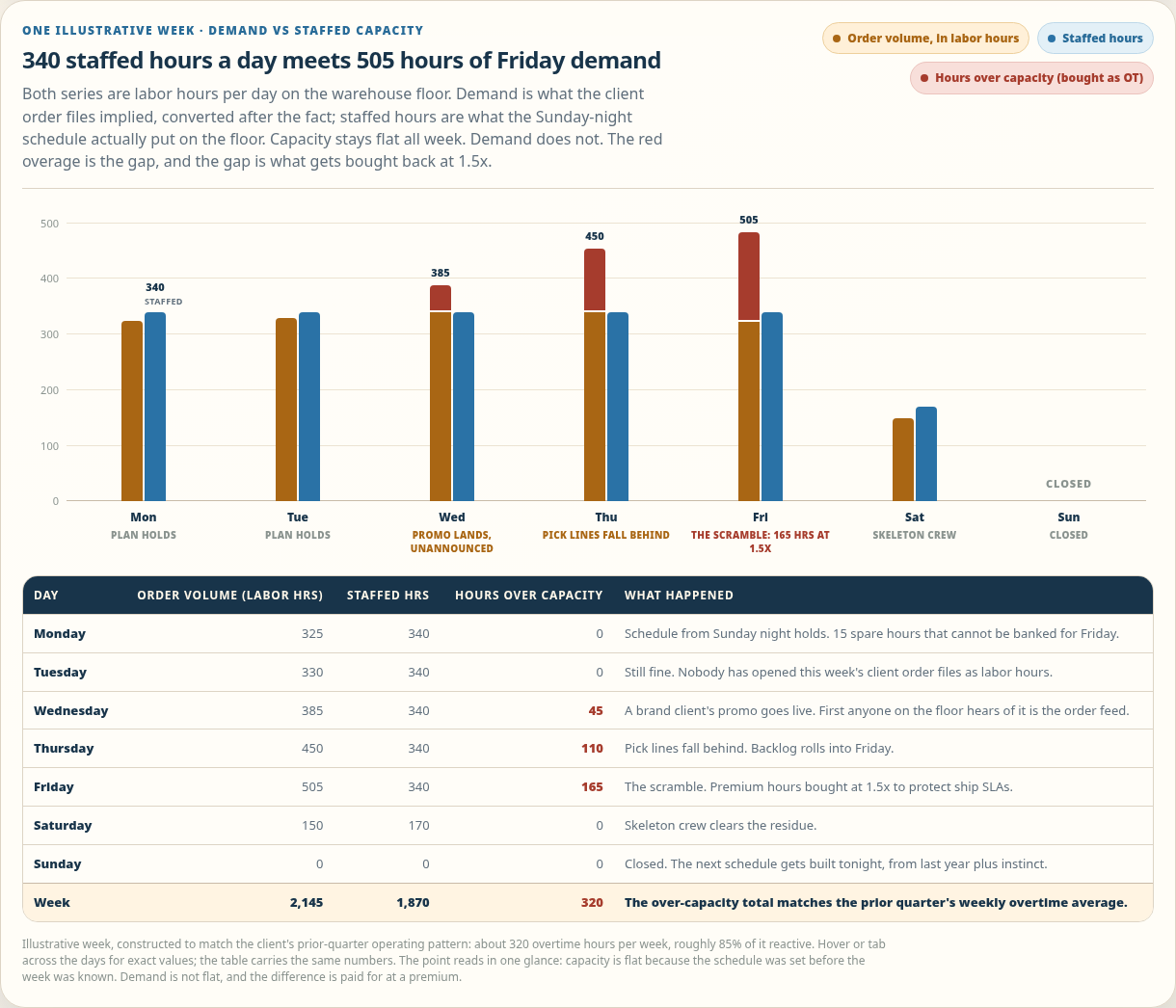
Engagement case study
Overtime down 22% in one quarter
A capacity model the GM can read, measured labor standards, and a Monday planning cadence. Deliberately no platform.
Read the case study →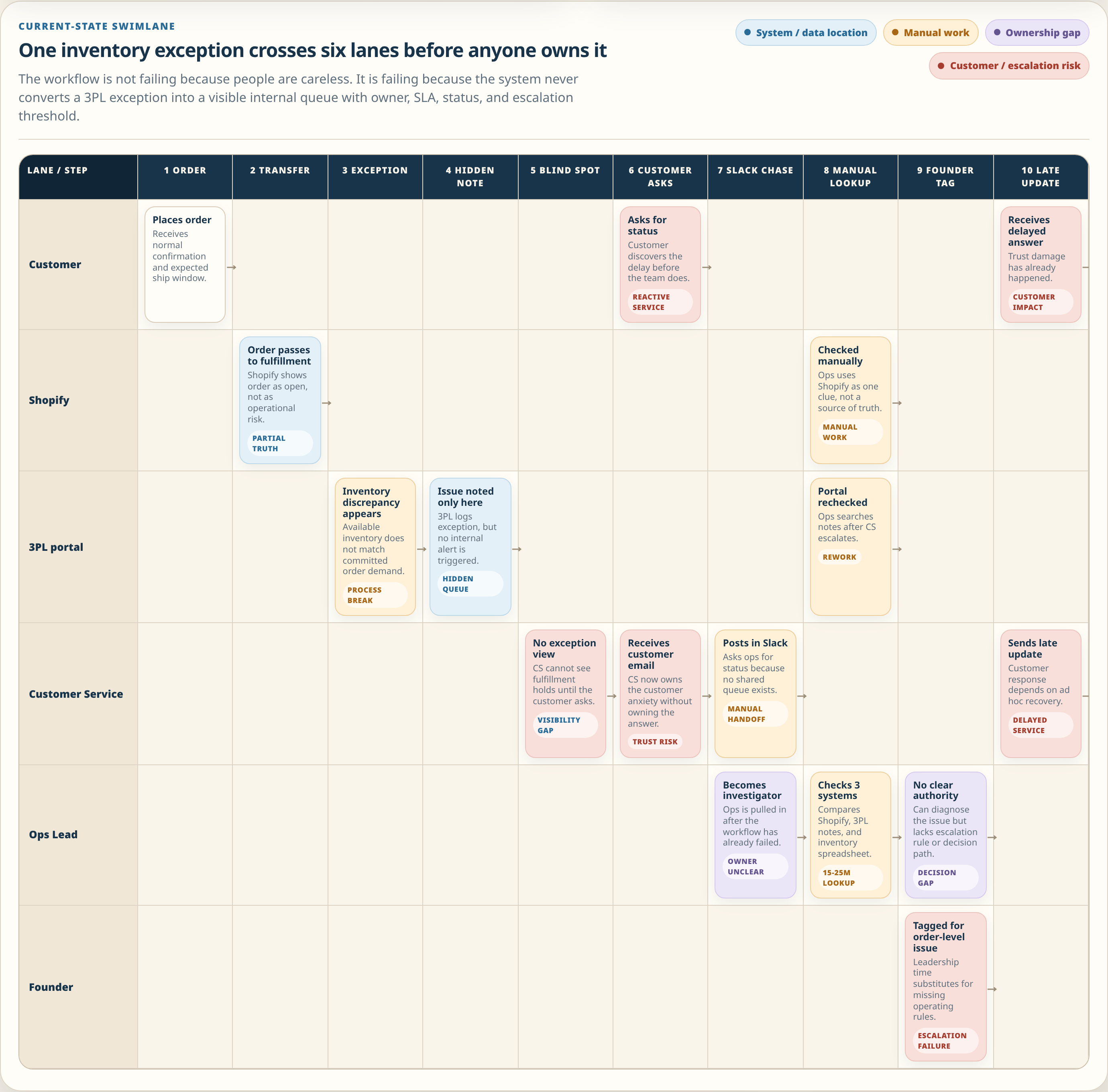
Audit case study
From status chasing to exception control
A $12M D2C food brand asked for AI. The audit found the real problem: exceptions nobody owned. Full diagnosis, exhibits, and the 30-day roadmap.
Read the case study →More builds, dashboards, and products on the Work page →
Start with the audit.
The Ops Workflow Audit + Automation Roadmap. A paid diagnostic starting at $2,500, scoped on the intro call. Final price and timeline depend on system access, sample volume, stakeholder count, and whether I need to see the operation in person. On-site time and travel are scoped separately.
Built for D2C and ecommerce brands, fulfillment-heavy teams, 3PL-adjacent operators, agencies, and founder-led companies where work is stuck in Slack, spreadsheets, portals, and founder escalations.
- Current-state workflow map. Where work actually breaks today.
- Failure-point diagnosis. Which handoffs and ownership gaps create the most risk.
- Operational risk assessment. What to fix first, by impact and complexity.
- Future-state operating model. The workflow made visible, owned, and time-bound.
- Owner and escalation rules. Who owns what, and when leadership gets involved.
- Automation readiness. What to automate now, what waits, what stays human.
- 30-day roadmap. What happens first, second, third, and after.
- Implementation options. What I can build next. The five packages →
The fix usually looks the same: one queue, one owner, one customer-safe status, one SLA clock, one escalation rule, one daily operating cadence. Automation comes after the workflow is stable.
This is not generic AI consulting, a chatbot project, or a full platform build. Some work should not be automated yet, and the audit will say so.
Select highlights.
Month-end close: 3 days to 4 hours
Redesigned fulfillment reporting for a D2C brand and eliminated 15 hours per week of manual data consolidation. Read the case study →
Overtime spend down 22%
Built a capacity planning model that cut overtime spend 22% in the first quarter. Read the case study →
$40K in missed payments caught
Replaced email-driven invoice tracking with a structured system. It caught $40K in missed payments within 60 days. Read the case study →
Send 3 to 5 recent examples where work got stuck, escalated, or required manual status chasing to dan@diazovate.com. I'll tell you whether this audit is the right fit.
The method comes from running operations, not from consulting decks: roughly $7M in efficiency savings across 12+ HelloFresh facilities, a non-ship rate cut from 4% to 0.02% at Nuts.com, operations standardized across 59 Success Academy school sites.
Tell me what is broken.
Send 3 to 5 recent examples where work got stuck, escalated, or required manual status chasing. I'll tell you whether the audit is the right fit, and what I would look at first.
dan@diazovate.com